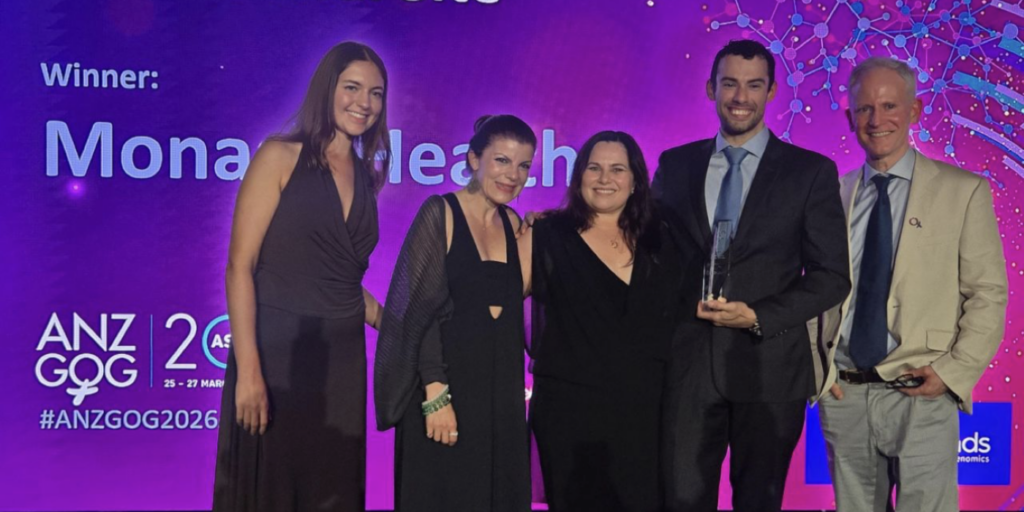

Left to right: Laura Spence, Sarah Thorne, Farah Ansari, Dr Allison Mo, Kylie Rushford, and Daniel Trakman.
A groundbreaking international study has revealed that a new drug, luspatercept, significantly outperforms the current standard treatment for anaemia in patients with lower-risk myelodysplastic syndromes (MDS).
The COMMANDS trial analysed the difference between the drugs luspatercept and epoetin alfa, which is the current standard treatment.
Clinical Director of Monash Haematology Professor Jake Shortt highlighted the importance of these findings.
‘Luspatercept not only improves the quality of life for patients by reducing their dependence on transfusions but also offers new hope for those suffering from this burden and potentially improves overall survival,’ he said.
MDS is a group of cancers in which immature blood cells in the bone marrow do not mature or become healthy blood cells.
Chronic anaemia is common in patients with MDS, often requiring management with red blood cell transfusions.
Monash Haematology, which is recognised by the International MDS Foundation as an MDS Center of Excellence, recruited the most patients internationally in the COMMANDS trial, which was conducted across 142 sites in 26 countries.
Pleasingly, the trial results have shown that luspatercept offers greater efficacy than epoetin alfa for transfusion-dependent patients who have not previously received erythropoiesis-stimulating agents (ESA), which stimulate the production of red blood cells in the bone marrow.
The trial, which included 363 patients globally, demonstrated that 60% of those treated with luspatercept did not require red blood cell transfusion for at least 12 weeks, compared to just 35% of those treated with epoetin alfa.
The trial was particularly beneficial to Australian patients as access to epoetin alfa is not listed for MDS on the Pharmaceutical Benefits Scheme– even though it is an accepted standard of care for MDS.
Importantly, every Australian patient enrolled in the study benefited from an active treatment they would not otherwise be able to access.
This significant improvement was observed across various patient subgroups, making luspatercept a new standard of care for patients who have not previously received agents to stimulate the production of red blood cells in the bone marrow.
The COMMANDS trial also monitored the safety of luspatercept, which recorded side effects including hypertension, anaemia, and pneumonia.
Despite this, the study found that overall, the benefits of luspatercept were deemed to outweigh the risks, with one death reported as potentially related to the drug.
As the medical community continues to seek better treatments for MDS, the results of the COMMANDS trial mark a significant step forward.
Monash Health begins recruitment for a follow-up trial
Building on the findings from this trial, Monash Health is currently recruiting for the ELEMENT trial, which seeks patients who had become anaemic before they require transfusions.
‘ELEMENT essentially picks up again where COMMANDS left off. The treatment groups are the same – luspatercept versus epoetin alfa– but the patients start treatment when they become symptomatic of anaemia, but before they need transfusions.
‘We anticipate the earlier treatment will work even better, as has already been shown for Epo. Importantly, when patients with low-risk MDS become transfusion dependent, their life expectancy decreases.
‘The hypothesis is that if we can prevent or delay transfusion dependence, not only will patients feel better, but they will live longer,’ said Professor Shortt.
International pilot trial REDDS2 to improve quality of life for MDS patients
Monash Health consultant Haematologist Dr Allison Mo is the lead investigator for a parallel study to investigate a personalised blood transfusion strategy for patients with MDS.
‘Anaemia is very common in patients with MDS and can be associated with symptoms of fatigue, reduced exercise tolerance and poorer quality of life.
‘Many patients receive regular chronic red cell transfusions, typically several units of red cells every few weeks.
‘The trial aims to investigate if giving patients weekly transfusions with fewer units can maintain a more stable haemoglobin level and if this can improve quality of life,’ she said.
To facilitate the timely delivery of weekly red blood cell transfusions, Dr Mo explained that participants are provided more extensively matched red blood cells, bypassing delays associated with prospective cross-matching on the day of transfusion.
She added that routine pre-transfusion testing results will inform the following week’s transfusion strategy, reducing the burden on patients and families.
The trial is currently open for recruitment at 9 sites across Australia, the UK, and the Netherlands, with an anticipated completion of recruitment by mid-2026.
The goal is to recruit a total of 30 participants from these sites.
If successful, Dr Mo said the results will help design a larger international clinical trial to determine the best transfusion strategy for improving patients’ quality of life and daily physical function.
Additionally, a qualitative sub-study will gather feedback from patients and hospital staff to shape future transfusion trials and practices in MDS.
This trial represents a significant step forward in the management of MDS, offering hope for improved patient outcomes and quality of life.
‘REDDS2 is an important example of investigator-led rather than industry-sponsored research.
‘Our trial unit works hard to support these important studies that answer key questions but would never be funded by a pharmaceutical company,’ said Professor Shortt.